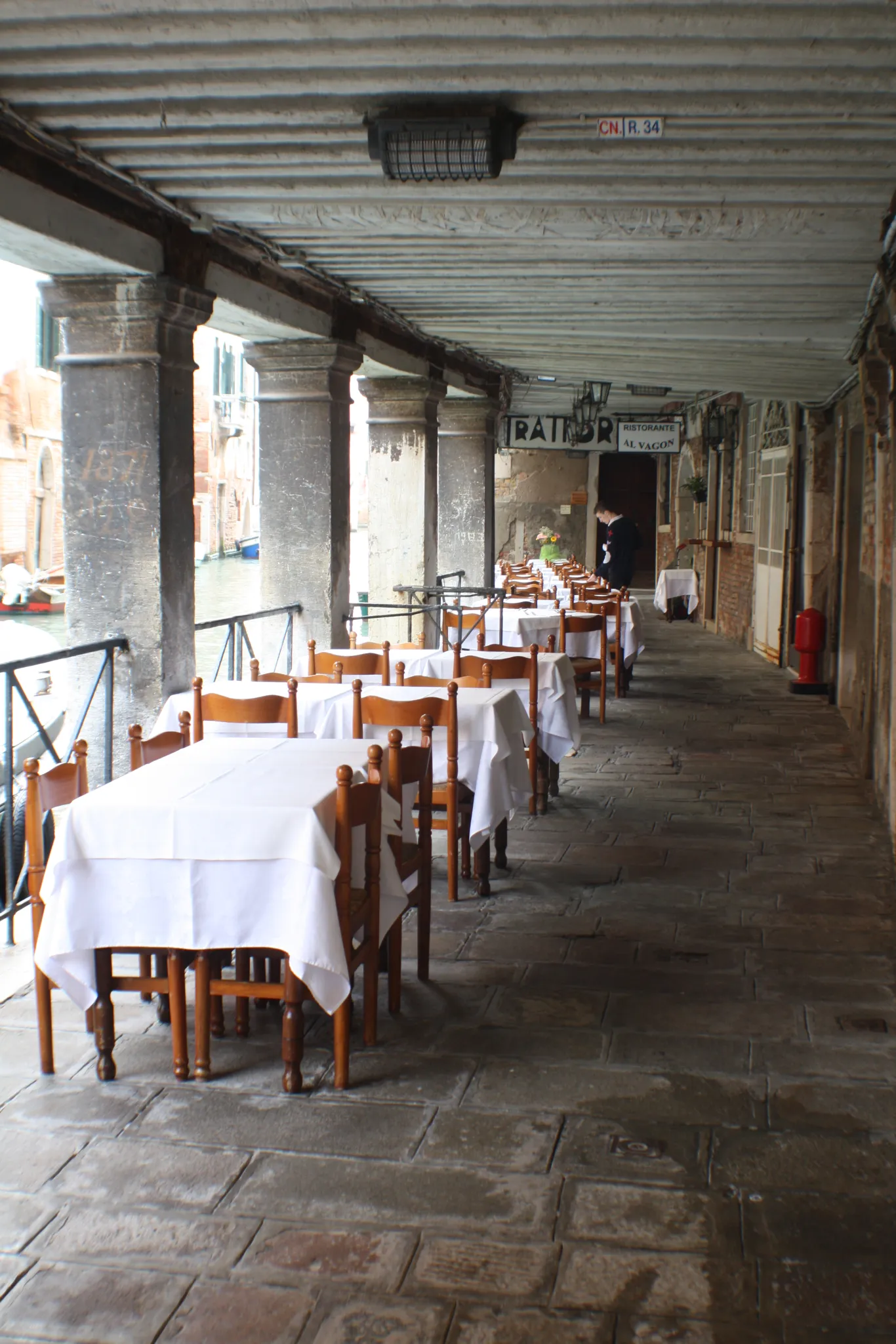
Some of you will remember a little prose experiment I did a couple of weeks ago. I was unsure whether I wanted to go on with it or not. A few of you, kind words and all, urged me to continue. Here’s part two.
Part 2
He was at the same table the next day. A different shirt, the same style. The same charcoal sport coat. A cup of cappuccino, half empty on the table in front of him. He was writing in his red and black and somehow staring into the crowds of tourists at the same time.
She had come to speak to him, but looking across San Marco, she hesitated. And wondered why. There was nothing intimidating about him. His clothes were nice enough but hardly ostentatious. He had bearing but nothing about him spoke of pride or arrogance. In short, he did not look like who he had been.
There was a peace to him, she thought. All he has done and accomplished, and he seemed content to simply be. She sensed no need for attention or power or any of the trappings of his success.
Maybe that is what held her back. She was not accustomed to men who were comfortable in their skin. Most of the men she interviewed were men of power or men who were grasping for power, and they all had an undercurrent of fear to them. She had the sense with all of them that they did not believe they deserved the money or power they held, and had a need to prove it again and again.
That was one of the hallmarks of her journalism. She understood that much. She found that vein of vulnerability and unveiled it, exposed it, and wrote it down for others to see. She was superb at leaving the reader believing the great ones were not so great after all. She had built her reputation on this premise, and it never failed her
Glancing up from her table across the square, she did not see that vulnerability in him, and it unnerved her a bit. And too, this was not an interview. In interviews, she was in control. Once she began talking to him, she knew her own vulnerabilities might emerge.
She was not certain she wanted that.
She finished her glass of Bellini and stood up, savoring the peach aftertaste. If she did not do it now, she would probably not see him again. She was due in France in two days. Catching him the same time at the same place was probably a fluke.
Three minutes later she was at his table. “Are you…”
“I was, once” He said, a gentle smile on his face. “I was wondering if you would come speak to me.”
“You saw me across the square?”
“I saw you yesterday. When I saw you today, I was sure it was not a fluke. Come, sit down, can I order you another Bellini?”
“I’ve been here for about a year. I still can’t speak decent Italian, but I recognize their drinks from a hundred yards.” He waved down a waiter, a different one from yesterday but with the same familiarity, and placed the order.
“Now,” he said. “What do you want with an old expatriot like me?”
“I wanted to thank you.”
He cocked his head slightly. Waiting.
“For my father and me, actually.”
He looked at her, really looked, like he was trying to read an almost famous piece of artwork whose name he should know but didn’t. Finally, he nodded, that gentle smile again.
She wondered what that smile really meant. He was harder to decipher than she thought he would be.
“Jacko Cantoni” he said. “That would make you Isabella.”
“How did you know that?” she asked. “Everyone says I look more like my mother.”
“You do, but your mannerisms are your father’s. You lean on your elbows at the table like he does. You lick your lips slightly before you talk. When you got up to walk over here, your eyebrows knitted, which his do when he was about to approach a problem he was unsure of. I did not see it at first. But when you told me you wanted to thank you for your father, I looked close. And there you were.
She wasn’t sure what to say, but he made it easier.
“You’re the reporter. I have read your work. You like truth. You seek it out, I think. That’s a brave occupation.”
“Brave? I have gone into a few battle zones. But not so much anymore.”
“Not the places, the seeking of truth. Most people don’t want it. It is often not pretty. Not flattering. A little scary. Haven’t you felt it when you were interviewing people of power?”
She had, but she was not accustomed to others understanding that part of what she did.
“Why?” he asked.
“Hey, I am the reporter.” She quipped. “I am supposed to be asking the questions.”
“Are you reporting on me now?”
“No.”
“Then you are not a reporter now. Why?”
For a moment she floundered. Why? It goes back a long time. She was a little girl. If her father had not told the stories so often, she’d never know who this man. She’d never know his name or all the things he had accomplished in technology and television.
But her father had told her the stories. Over and over again. “You gave my father his first job in the industry. Everything he accomplished started with you. He was utterly unqualified and you hired him anyway.” She paused.
I guess I have heard about you all my life, and wanted to see if the reality matched the stories.
“Probably not. Stories take on a life of their own. I rarely recognize myself in the press. Your father, He did well.”
“He did. My whole life was because of you. Because of what you gave him, he was able to send me to the best schools. His contacts, which were yours before, gave me my first chance at CNN.”
He smiled and lifted his cup. There was a mischievousness to him that did not come across when he was on television. The wrinkles when he smiled ran deeper than she had seen on television.
“What makes you think he was unqualified?” he asked.
“It’s what he has always said.”
“Did he tell you what he was doing when we met?”
“He was a college senior.”
“A grad student, actually. Majoring in what?”
“English. Specifically “Metaphysical Poetry.”
“And wasted there.”
“What?”
He took another sip from his cup. It was the last of the cappuccino. “Don’t get me wrong. We’re all glad we have the Metaphysical poets. John Donne and his lot. But your father had the same thing that makes you a good reporter. Or at least the same two things. He just never saw it in poetry,
I remember him, some kind of student intern if I remember. And my teams were rebuilding the TV studios in the same building. He was a pest. The best kind.”
“I have no idea what you mean.” She said.
“They never do.”

